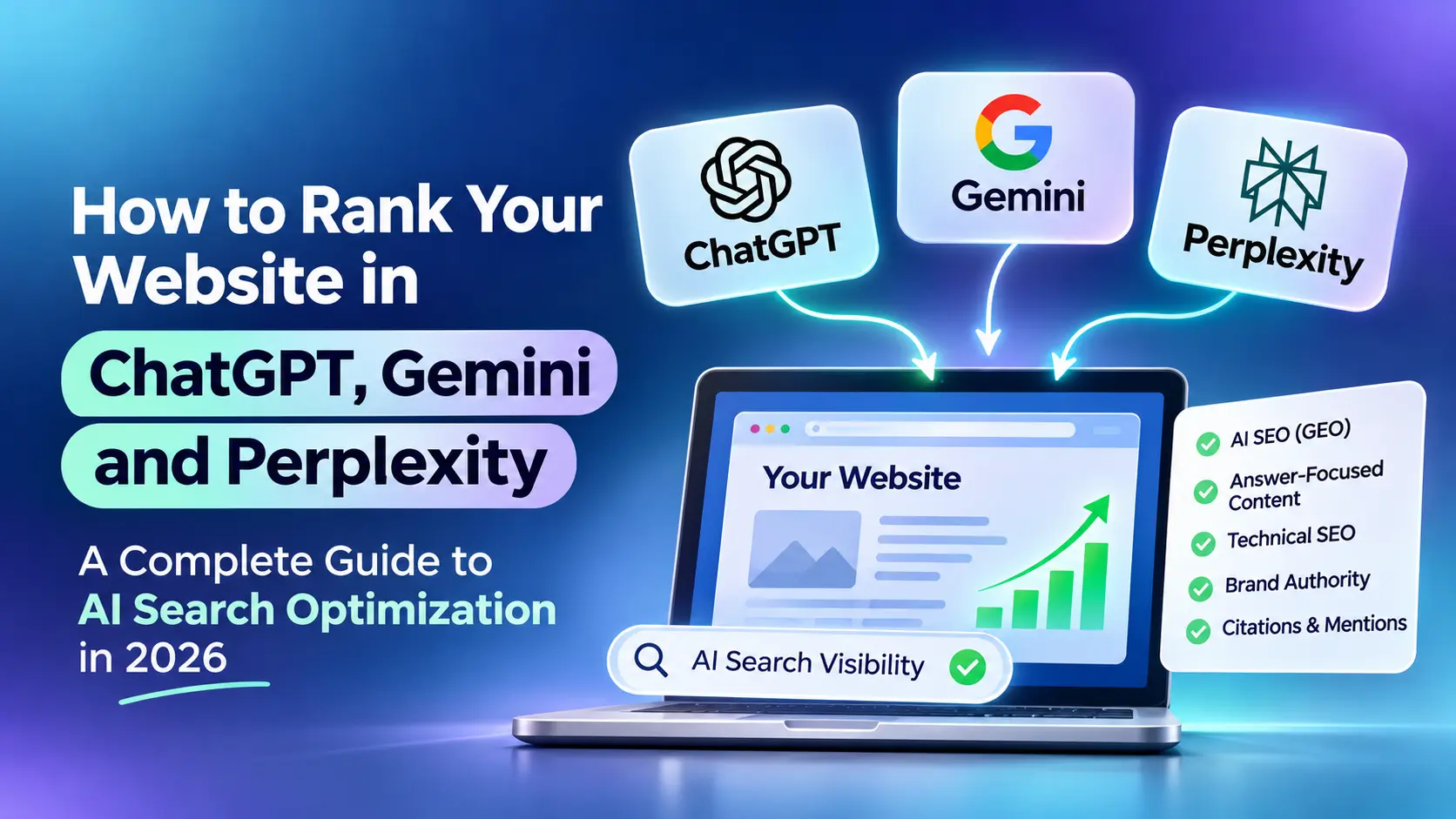
AI Search Optimization in 2026
How to Rank Your Website in ChatGPT, Gemini and Perplexity: A Complete Guide to AI Search Optimization in 2026 Search behaviour is changing rapidly. Earlier, people primarily depended on Google and other traditional search engines to discover websites, products and services. Today, AI-powered platforms such as ChatGPT, Google Gemini and Perplexity are becoming important tools for finding information, comparing businesses and getting recommendations. Instead of searching with short keywords, users are asking detailed questions and expecting direct, personalized answers. This shift is creating new opportunities for businesses to improve their online visibility through AI search optimization. But how can you make your website visible on these platforms? Is traditional SEO enough, or do you need a different strategy to appear in AI-generated answers? In this guide, we will explore how to rank your website in ChatGPT, Gemini and Perplexity using practical SEO and Generative Engine Optimization (GEO) strategies. What Is AI Search Optimization? AI Search Optimization is the process of improving website content, structure and online authority to increase the chances of being discovered, referenced or cited by AI-powered search platforms. Traditional search engines generally display a list of relevant webpages based on a user’s search query. AI-powered platforms, on the other hand, can analyze information from multiple sources and generate a summarized response with relevant links or citations. For example, consider someone searching for: “Who is the best digital marketing specialist in Kerala?” Traditional search engines may display websites, business listings and advertisements. An AI-powered platform may generate a conversational answer based on information it can access and evaluate. This is where Generative Engine Optimization (GEO) becomes important. GEO focuses on improving brand and website visibility in generative AI experiences. It works alongside traditional SEO rather than replacing it. How Do ChatGPT, Gemini, and Perplexity Find Website Content? Before implementing AI SEO strategies, it is important to understand how these platforms discover and use website information. 1. ChatGPT ChatGPT offers web search capabilities that can retrieve relevant information from publicly accessible websites and provide answers with supporting links. When users ask questions that require current or specific information, ChatGPT Search can retrieve relevant webpages and use them to generate responses. For website owners, allowing OpenAI’s search crawler, OAI-SearchBot, to access relevant pages is an important technical consideration. Your website should also have useful, accessible, and well-structured content that can answer relevant user queries. 2. Google Gemini Google Gemini is Google’s AI assistant, while Google Search provides AI-powered experiences such as AI Overviews and AI Mode. These experiences can use Google’s search systems to discover relevant information and provide links to supporting websites. For businesses, maintaining strong Google SEO fundamentals is important for improving discoverability. Your website should be crawlable, indexable, mobile-friendly, and supported by helpful content that satisfies user search intent. 3. Perplexity AI Perplexity is an AI-powered answer engine that searches the web and provides conversational responses with source citations. It retrieves information from relevant webpages to support its answers. Website owners should ensure that important content is accessible to Perplexity’s search crawler, PerplexityBot, and that their websites are not unintentionally blocking legitimate crawling requests. Each platform has its own discovery and retrieval processes. Therefore, appearing in one platform does not automatically guarantee visibility in the others. 10 Effective Strategies to Rank Your Website in ChatGPT, Gemini, and Perplexity If you want your website to gain visibility across AI-powered search platforms, focus on the following optimization strategies. 1. Strengthen Your Traditional SEO Foundation Traditional SEO remains one of the most important foundations of AI search optimization. AI-powered search experiences still depend on discovering and understanding relevant information from the web. A technically weak or poorly optimized website may struggle to establish visibility. Start by improving these SEO elements: Use Google Search Console to monitor indexing issues, organic search performance and website visibility. A technically healthy website creates a stronger foundation for search discovery. 2. Create High-Quality, Answer-Focused Content AI platforms are designed to understand questions and generate relevant answers. Therefore, your website content should address the actual questions your target audience is asking. Instead of publishing generic articles, create detailed and useful content that solves specific problems. For example, a digital marketing website can publish articles targeting questions such as: Use clear headings, short paragraphs, bullet points and practical examples. Provide direct answers to important questions before expanding into detailed explanations. This approach makes your content easier for users and search systems to understand. 3. Optimize Your Website for Conversational Search Queries People interact with AI platforms differently from traditional search engines. Instead of entering short keywords, they often ask complete questions. For example: Traditional search query:“Best SEO agency Kerala” Conversational search query:“Can you recommend a reliable SEO agency in Kerala for a small business?” Your content strategy should consider both types of searches. Include natural-language questions, long-tail keywords and question-based headings in relevant pages. You can identify these questions through: Do not create separate pages for every minor variation of a question. Organize related queries into useful, comprehensive content. 4. Build Topical Authority Through Content Clusters Topical authority refers to demonstrating consistent knowledge and expertise around a particular subject through relevant content. For example, if your website focuses on digital marketing services, you can create a content cluster around SEO. Main topic: Search Engine Optimization Supporting articles: Connect these articles using relevant internal links. This creates a logical content structure and helps users explore related information. Publishing valuable supporting content also helps establish your website as a useful resource within your industry. 5. Allow AI Search Crawlers to Access Your Website This is one of the important technical considerations for AI search visibility. AI platforms use different crawlers and retrieval systems to discover website information. For example: Check your robots.txt file to ensure that relevant website sections are not unintentionally blocked. For example, the following robots.txt configuration allows the three named crawlers: User-agent: OAI-SearchBotAllow: / User-agent: PerplexityBotAllow: / User-agent: GooglebotAllow: / However, allowing a crawler does not guarantee that your website will be indexed, selected or